Home · Insights · Succession and the operator partner · Succession start date
Guide · Succession and the operator partner
Why a late succession start leaves founders fewer exit routes
By Orvane team · 5 October 2026 · 7 min read
Last updated
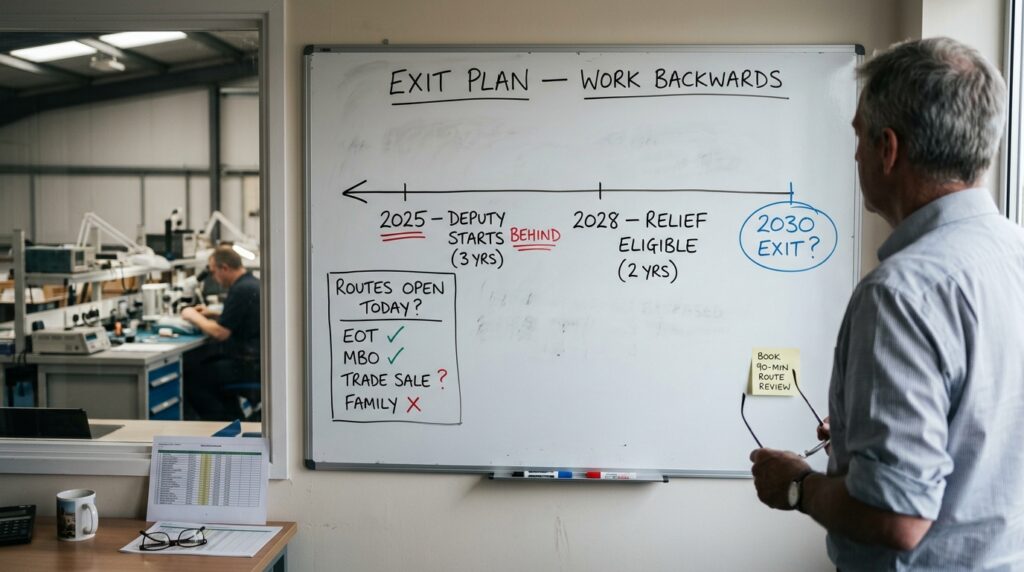
A founder's wall planner with a provisional exit year marked and milestones counted backwards from it.
Founders keep more succession routes open by setting a provisional exit year and scheduling backwards, turning statutory lead times into milestones they can plan for. Business Asset Disposal Relief needs its conditions met for 2 years before a sale, and 89% of employee ownership trust deals pay founders over time (Pendleton and Robinson, 2025).
Tax deadlines move founders faster than advice does. In the 2024–25 tax year 61,000 taxpayers claimed Business Asset Disposal Relief (BADR), a 45% rise on the year before, after two rate increases were announced in advance (HMRC capital gains statistics, 2026). The relief rate rose from 10% to 14% in April 2025 and reached 18% on 6 April 2026.
In a £2m–£5m technical business specifically, the founder is often the one person who holds every key customer relationship and the reasoning behind every price. That founder usually knows succession needs attention. What usually comes last is the date.
This article argues that the real cost of a late start is a shorter list of succession routes that still work, and that a backwards schedule protects that list. It sets out the lead times that fix the minimum clock and a prompt for each barrier behind the delay. A five-question readiness check closes the article.
A late succession start is a planning issue
A late start is mainly a scheduling failure: each succession route carries a lead time, and a founder who begins inside it loses that route. Three drivers explain why the start slips.
- The business is the founder’s identity. A two-year study of 34 founders found that those most invested in their company separated from it late and felt the exit as a loss, even after a successful sale (Rouse, Academy of Management Journal, 2016).
- The date stays open. When the government set dated rate rises, BADR-eligible disposals rose from 42,000 to 61,000 in a single tax year, which suggests founder timing follows external dates when they exist.
- The task feels aversive. A meta-analysis of 691 correlations found task aversiveness and task delay among the strongest predictors of procrastination (Steel, Psychological Bulletin, 2007).
In summary, the delay comes from how the decision is framed and scheduled, which means it responds to method.
Exhibit 1. Statutory lead times put most succession routes at least two years away
| Rule or route | Lead time | What it means for your start date |
|---|---|---|
| Business Asset Disposal Relief | Qualifying conditions met for at least 2 years before the sale | Eligibility must be in place two years before the date you want to sell |
| Business Relief (inheritance tax) | Business owned for at least 2 years before death | Restructuring late can leave assets outside the relief |
| Employee ownership trust | 89% of deals use deferred consideration; median payment term 6 years | The business has to run well without you while you are being paid |
| BADR rate | 10% → 14% (April 2025) → 18% (April 2026) | Rate changes are announced ahead, which helps only founders already eligible |
Source: GOV.UK, Business Asset Disposal Relief, https://www.gov.uk/business-asset-disposal-relief; GOV.UK, Business Relief for Inheritance Tax, https://www.gov.uk/business-relief-inheritance-tax/what-qualifies-for-business-relief; Pendleton and Robinson, International Review of Applied Economics, 2025, https://doi.org/10.1080/02692171.2025.2475136. Figures checked 4 October 2026.
Why does the start date matter for which succession routes stay open?
The start date matters because the routes that best protect a team tend to need the longest runway. In employee ownership trust sales, 89% of deals used deferred consideration with a median payment term of 6 years (Pendleton and Robinson, International Review of Applied Economics, 2025). In the same study, 72% of selling owners strongly agreed that long-term stability for the company was a reason to sell.
That route became less generous on 26 November 2025, when the tax relief on disposals to an employee ownership trust fell to 50% of the gain (GOV.UK, 2025). Employee ownership kept growing. The Employee Ownership Association counted 2,925 employee-owned businesses in September 2026, with 125 transitions so far that year.
What goes wrong when an outside deadline sets the exit date?
The 2024–25 spike looks like proof that founders can move fast when they need to. It also shows who was able to move: only owners whose businesses already met the two-year conditions could sell early and keep the lower rate. Everyone else watched the date pass.
We call this the borrowed deadline: an external date, such as a tax change or an unsolicited offer, sets the timing, and the timing then picks the route. In a study of 1,192 Finnish owners aged 55 and over, 26.1% intended to close their firm, with one-person firms the likeliest to close (Viljamaa et al., Journal of Small Business and Enterprise Development, 2024). Whether late starters also get worse terms is an assumption here, because the published data covers intentions and routes rather than prices.
A late train booking: the seats exist, but few of them suit you
Imagine booking a train to a family wedding on the morning you need to travel. You will get there. A founder who starts succession inside the lead time faces the same timetable: the seats left leave at awkward times, and the routes on offer rarely match what they wanted for the business.
Three actions for founders to keep their succession routes open
Exit year — writing down a provisional date and scheduling backwards
A provisional year turns succession from an intention into a schedule. Once it is written, the lead times in Exhibit 1 become milestones counted backwards, the same way a project plan builds its critical path from a launch date. The year can move. Its job is to make the next 24 months concrete.
Illustrative example
A 22-person calibration services firm has a founder aged 61 and an undated exit plan. The founder writes down 2030, counts back two years for relief eligibility and three more for a deputy to take over operations, and finds the deputy plan should have started in 2025. The schedule shows the first milestone is 1 year behind, with 4 years left to recover it.
Founder role — separating what only you do from what the business does
The identity barrier weakens when the founder’s role is written down as tasks instead of carried as a sense of self. When we map a role like this, each task in a typical month is marked as founder-only, delegable or documentable, which shows how much of the business already runs on its own. Rouse found that founders whose identity extended beyond one company disengaged earlier and found the exit easier.
Illustrative example
An energy-metering installer with 30 staff maps the founder’s month and finds 41 recurring tasks, 9 of them founder-only. Over six months the founder documents and hands over 5 of the 9. The 4 that remain sit in key customer relationships, which now have their own handover plan.
First step — shrinking the task to a 90-minute route review
Avoidance eases when the task gets smaller, since aversiveness is one of the strongest drivers of delay in Steel’s meta-analysis. The founder books 90 minutes with their accountant to answer two questions: which routes are open today, and which reliefs the business qualifies for now. A defined output, a one-page route list, keeps the meeting short enough to happen this month.
Illustrative example
The founder of a data-cabling contractor with three sites has postponed “succession planning” for three years. A single 90-minute review produces a one-page list of 4 routes. Two of them, an employee ownership trust and a management buyout, go forward to a second session six weeks later.
How ready is your business for a planned succession?
Score each question 0, 1 or 2. Add up the total, then read the band underneath it.
| Question | 0 | 1 | 2 |
|---|---|---|---|
| Have you written down a provisional exit year? | No | Partly | Yes, documented |
| Do you know which succession routes and tax reliefs your business qualifies for today? | No | Partly | Yes, documented |
| Are key decisions, prices and customer relationships documented? | No | Partly | Yes, documented |
| Has someone other than you run the business for two weeks? | No | Partly | Yes, documented |
| Have you reviewed your routes with an adviser in the last 12 months? | No | Partly | Yes, documented |
0–3: Write a provisional exit year this week and book the 90-minute route review. 4–7: Check each route against the lead times in Exhibit 1 and fix the earliest missed milestone. 8–10: Test the plan by stepping away for two weeks and listing what came back to you.
What to do next
This method stops working when time itself runs out. A sudden illness or the loss of a customer worth a third of revenue can override any schedule. A business whose value sits in the founder’s personal relationships needs specialist legal and tax advice before a route review.
For every other founder, a provisional exit year scheduled backwards keeps more succession routes open. This week, write that year down, subtract two years for relief eligibility and put the 90-minute route review in the diary.
Key takeaways
- Business Asset Disposal Relief conditions must be met for 2 years before a sale, so eligibility planning starts two years before the target date.
- In employee ownership trust sales, 89% of deals used deferred consideration with a median 6-year payment term (Pendleton and Robinson, 2025).
- BADR-eligible disposals rose 45% to 61,000 in 2024–25 once dated rate rises were announced, suggesting many founders act when a date is fixed (HMRC, 2026).
Sources
- GOV.UK, “Business Asset Disposal Relief”, October 2026. www.gov.uk
- HM Revenue & Customs, “Capital Gains Tax commentary”, August 2026. www.gov.uk
- GOV.UK, “Capital Gains Tax: Employee Ownership Trusts relief reduction”, November 2025. www.gov.uk
- GOV.UK, “Business Relief for Inheritance Tax: what qualifies”, October 2026. www.gov.uk
- International Review of Applied Economics (Pendleton & Robinson), “Employee ownership trusts: an employee ownership success story”, 2025. doi.org
- Journal of Small Business and Enterprise Development (Viljamaa, Joensuu-Salo & Varamäki), “Retiring entrepreneurs and succession planning: does entry mode determine exit strategy?”, 2024. www.sciencedirect.com
- Academy of Management Journal (Rouse), “Beginning's end: how founders psychologically disengage from their organizations”, 2016. doi.org
- Psychological Bulletin (Steel), “The nature of procrastination: a meta-analytic and theoretical review”, 2007. doi.org
- Employee Ownership Association, “Growth strategy update: UK closes in on 3,000 employee-owned businesses”, September 2026. employeeownership.co.uk
This article draws on 9 sources, including GOV.UK and HMRC statistics and peer-reviewed studies in management and psychology, checked on 4 October 2026. Figures are the latest available at that date. The study of owners' exit intentions covers Finland, and published UK data describes routes and reliefs rather than sale prices. The practical steps come from applying backwards scheduling and process mapping to succession planning.

Great businesses deserve great successors.
We acquire and improve UK technical businesses in metrology, energy, data infrastructure and SaaS, and write about what it takes.
Planning your own succession?
Orvane buys UK technical businesses from founders and keeps them. The criteria and the ninety-day plan are published in full.
Get the monthly article
One practical article a month, by email.
Explore topics
Related insights
Pillar page
Related article
Related article
Read next

15 October 2026 · 8 min read

13 October 2026 · 8 min read

13 October 2026 · 7 min read
Great businesses deserve great successors.
We acquire and improve UK technical businesses in metrology, energy, data infrastructure and SaaS, and write about what it takes.
Explore topics
Get the monthly article
One practical article a month, by email.