Home · Insights · Succession and the operator partner · Run without you
Guide · Succession and the operator partner · Metrology & calibration
How to prove your technical business can run without you
By Orvane team · 11 October 2026 · 8 min read
Last updated
A laboratory bench with a handover file and a staff competence matrix
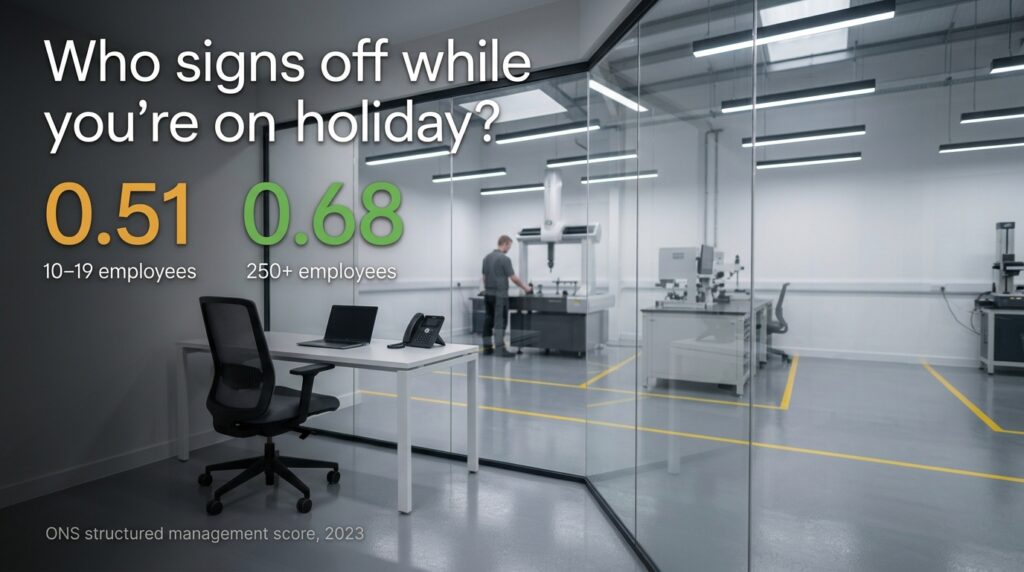
Buyers check four things: how decisions get made when the founder is away, who holds the biggest customer relationships, whether personal and company money are separate, and whether each accredited role has a trained deputy. Small companies start furthest behind: in 2023, those with 10–19 employees scored 0.51 on the ONS structured management scale, against 0.68 at 250 or more.
When a founder takes two weeks off, the business shows what it can do without them. Quotes wait for sign-off, and the biggest customer rings the founder’s mobile instead of the office. A buyer’s adviser will ask about exactly those two weeks, because whatever waits for the founder is a risk the buyer has to price.
In technical SMEs specifically, the founder often prices the difficult jobs and looks after the biggest account in person. If you run a £2m–£5m laboratory or test house and expect to sell within five years, this article is for you. Your accounts may already be tidy.
This article argues that buyers price what keeps working after the founder steps away, and that you can measure it years before a sale. You will get three actions that shorten the list of things only you can do, and a five-question scorecard to track them. It sits within our wider insights on succession and the operator partner.
Founder dependence is a structural issue
Founder dependence is a structural issue: it lives in how decisions, customer accounts and accredited roles are organised. Small companies drift into it because the founder is usually the quickest route to an answer. Over a decade, the business learns to wait for one person.
- Decisions route upwards. In the ONS survey of 2023 practice, businesses with 10–19 employees scored 0.51 on structured management, against 0.68 for those with 250 or more (ONS, 2024).
- Key accounts sit with one person. Revenue often rests on two or three customers, and the most important of them is frequently managed by the owner in person.
- Accredited roles carry names. UKAS asks to be told in advance of a change of ownership, including any planned change to key personnel, so a buyer will ask who holds each technical role (UKAS).
Exhibit 1. Structured management scores rise steadily with company size
| Employees | Average score (0–1) | Gap to the 250+ band |
|---|---|---|
| 10–19 | 0.51 | 0.17 |
| 20–49 | 0.58 | 0.10 |
| 50–99 | 0.63 | 0.05 |
| 100–249 | 0.65 | 0.03 |
| 250 or more | 0.68 | — |
Source: Office for National Statistics, Management practice scores and distributions by firm characteristics, UK (2023 survey year, corrected edition, 2024), https://www.ons.gov.uk/economy/economicoutputandproductivity/productivitymeasures/datasets/managementpracticescoresanddistributionsbyfirmcharacteristicsuk. Figures checked 10 October 2026. Gap column calculated from the ONS scores.
In summary, every driver reflects a choice about where work sits, and two or three years of steady effort can move it.
Why does transferability matter for the terms a founder gets?
Transferability matters because a buyer pays for future profit, and profit that depends on one person carries a risk the buyer has to price. A study of 732 medium-sized manufacturers in the US, France, Germany and the UK found that management practice scores track productivity and survival (Bloom and Van Reenen, 2007). The same study linked weak management to family companies handing control to the eldest son.
Due diligence tests this directly. Buyers look at how employees reach decisions and how many customer relationships run through the owner, and they check whether personal spending passes through the company. Employee ownership, a route that needs your managers to carry on unaided after the founder leaves, now covers 2,925 UK businesses (Employee Ownership Association, 2026), so the question reaches well beyond trade sales.
What goes wrong when the founder is the system?
When the founder is the system, the business looks strongest exactly where a buyer finds it weakest: in its customer relationships and its quality record. Loyal customers and clean audits both read as assets, yet each may rest on borrowed capability, meaning skill and goodwill the business uses every day that belong to the founder and leave with them. The sharpest case is the key customer who is also the owner’s friend, and who follows the owner out of the door once the sale completes.
Concentration alone tells you less than its reputation suggests. Studies of listed US suppliers found that it hurts profitability early in a relationship and helps as the relationship matures (Irvine, Park and Yildizhan, 2016), with concentration on government customers lifting profitability and concentration on corporate customers lowering it (Cohen and Li, 2020). For a small company, the more telling test is who holds each large relationship and whether it would survive a change of owner.
A borrowed toolbox: what leaves with the founder
Imagine buying a workshop where the best tools belong to the foreman and go home in his van each evening. During the viewing the benches look full and the work looks excellent. The gap appears on the first Monday after he retires, when half the jobs on the board need a tool that has gone.
A founder’s contacts and sign-off authority work the same way. The buyer’s adviser spends due diligence finding which tools are borrowed. Move them onto the benches before that starts.
Three actions for founders to shorten the list only they can do
Decisions — delegating the calls only you make
List every decision that reaches you in a normal fortnight, then give each one an owner and a written limit. A decision with a documented threshold can be made by anyone trained on it, while an undocumented one waits for you and slows every job behind it. When we map how decisions move through a business, we look first at which approvals stalled during the founder’s last holiday.
Illustrative example
A 30-person calibration laboratory found its founder approved every quotation above £5,000, about 40 a month. It introduced a two-tier authority matrix, with the operations manager signing up to £25,000. Within six months, founder approvals fell to about 6 a month, and the operations manager covered a two-week absence without a call.
Customers — moving each relationship from a person to a process
For each of your three largest customers, name a second contact in your business who meets them regularly and has been introduced by you. A relationship held by two people survives one of them leaving, and a written account plan lets a newcomer pick it up without starting again. Some buyers tie part of the price to key customers staying for an agreed period, such as three years, so a well-held account protects your own proceeds.
Illustrative example
An engineering test house drew 45% of revenue from one customer whose relationship ran through the founder. Over 18 months, the technical manager joined every quarterly review and took over day-to-day contact. By the sale, the founder attended 1 of 4 reviews. The customer had renewed for 3 years.
Accreditation — training a deputy for every named role
List each role your accreditation depends on, such as technical manager and quality manager, and check that each one has a trained, documented deputy who has signed real work. UKAS expects advance notice of planned changes to key personnel when ownership changes, so a single named signatory becomes a question for the buyer and for the assessor. A competence record and witnessed sign-offs for each deputy turn that question into a document you can hand over on the first day of due diligence.
Illustrative example
A 20-person calibration laboratory had one authorised signatory for each of its three measurement areas. It trained and recorded a second signatory for each over nine months, with witnessed work at the next surveillance visit. Its single points of failure across the scope fell from 3 to 0 before it began talking to advisers.
How ready is your business to run without you?
A business is close to ready when it scores 8 or more on the five questions below. Score each question 0, 1 or 2, add the scores, then read the band underneath. Answer for the business as it runs today.
| Question | 0 | 1 | 2 |
|---|---|---|---|
| During your last holiday, were decisions made without contacting you? | No | Partly | Yes, documented |
| Can managers approve prices and purchases up to a written limit? | No | Partly | Yes, documented |
| Does each of your three largest customers have a second named contact here? | No | Partly | Yes, documented |
| Are personal and company spending fully separate in the accounts? | No | Partly | Yes, documented |
| Does every accredited key role have a trained, documented deputy? | No | Partly | Yes, documented |
0–3: Start with the decision log in action one, because the business still runs through you. 4–7: Pick your lowest-scoring question and fix it within six months. 8–10: Ask your accountant to test each answer the way a buyer’s adviser would.
What to do next
This method stops working where the founder’s own expertise is the product, as in a specialist consultancy built on one person’s reputation. There, the honest route is a longer planned handover or a different exit. Transferability work only narrows that gap.
Shortening the list of things only you can do is what lets a buyer price the business with confidence. This week, keep a log of every decision that reaches you, then mark each one someone else could make with a written rule.
Key takeaways
- A business is close to ready when it scores 8 of 10 on five checks, from decisions taken during the founder's holiday to trained deputies for accredited roles.
- In 2023, UK businesses with 10–19 employees scored 0.51 on the ONS structured management scale, against 0.68 for businesses with 250 or more employees.
- A founder's last holiday is a ready-made transferability test: list every decision that waited for their return and give each a written owner.
Sources
- Office for National Statistics, “Management practice scores and distributions by firm characteristics, UK (corrected)”, 2024. www.ons.gov.uk
- UKAS, “Change of ownership, name or legal entity”, Checked October 2026. ukas.com
- The Quarterly Journal of Economics, “Bloom and Van Reenen: Measuring and explaining management practices across firms and countries”, November 2007. doi.org
- The Accounting Review, “Irvine, Park and Yildizhan: Customer-base concentration, profitability, and the relationship life cycle”, 2016. doi.org
- The Accounting Review, “Cohen and Li: Customer-base concentration, investment, and profitability: the US government as a major customer”, 2020. doi.org
- Employee Ownership Association, “Growth Strategy update: UK closes in on 3,000 employee owned businesses”, 2026. employeeownership.co.uk
This article draws on 6 sources, including ONS management survey data and UKAS accreditation rules, plus academic studies in The Quarterly Journal of Economics and The Accounting Review, checked on 10 October 2026. Figures are the latest available at that date. The customer concentration research covers listed US suppliers, which are far larger than most businesses reading this. The practical steps come from applying process mapping and audit-preparation method to this sector.

Great businesses deserve great successors.
We acquire and improve UK technical businesses in metrology, energy, data infrastructure and SaaS, and write about what it takes.
Planning your own succession?
Orvane buys UK technical businesses from founders and keeps them. The criteria and the ninety-day plan are published in full.
Get the monthly article
One practical article a month, by email.
Explore topics
Related insights
Pillar page
Related article
Related article
Read next

6 October 2026 · 7 min read
15 October 2026 · 8 min read

13 October 2026 · 8 min read
Great businesses deserve great successors.
We acquire and improve UK technical businesses in metrology, energy, data infrastructure and SaaS, and write about what it takes.
Explore topics
Get the monthly article
One practical article a month, by email.